
The rules, place by place
| Where the house is | A homeowner removing a tree on the home lot | The catch |
|---|---|---|
| City of Green Cove Springs | No city permit for one- and two-family dwelling units (Sec. 113-276(2)) | Trees within 20 feet of the St. Johns Avenue right-of-way from Forest Street to Clay Street, and trees an owner chose to have designated protected |
| Unincorporated Clay County: Fleming Island, Oakleaf Plantation, Middleburg, Lake Asbury, Doctors Inlet and the rest | Exempt if the lot was a single-family lot of record before Jan 28, 2003, or isn't part of a major subdivision created after that date (Sec. 6-2(3)) | On a lot in a major subdivision created after Jan 28, 2003, a tree 4 inches or more across needs a landscape plan approved by the zoning director |
| Town of Orange Park | The town has a Residential Tree Removal application | Which trees and sizes it covers wasn't confirmed for this site; ask the town |
| City of Keystone Heights | Exempt: lots zoned for one- and two-family dwellings that were under 10 acres on July 1, 2013 (Sec. 17-221(a)(2)) | Larger or differently zoned lots need a permit for trees over 4 inches DBH |
| Town of Penney Farms | No tree ordinance was found for this site | Ask Town Hall before cutting |
| Anywhere in the county | Fla. Stat. 163.045: with qualifying documentation that the tree is an unacceptable risk, no local notice, permit, fee, mitigation or replanting can be required for a single-family home | The documentation has to meet the statute's terms; homeowners associations aren't covered by it |
Mailing addresses don't decide this: some houses with an Orange Park address sit outside the town and follow the county code. The offices below can tell you which side of a line you're on.
Inside Green Cove Springs city limits
The city's tree rules are in Chapter 113, Article VII of its Land Development Code, last amended for these sections by Ordinance O-23-2023 on September 5, 2023. Sec. 113-275(b) makes it unlawful to remove a tree "located on any property without obtaining a permit," and Sec. 113-275(a) counts as removal anything that will kill it, such as heavy-machinery root damage, grade changes or fire. Then Sec. 113-276 lists the exemptions, and the second is short: "One- and two-family dwelling units." Another covers "Nonnative trees as defined by IFAS, Florida Friendly Landscaping." For most single-family houses in the city, that settles it. Two exceptions remain.
The St. Johns Avenue canopy zone
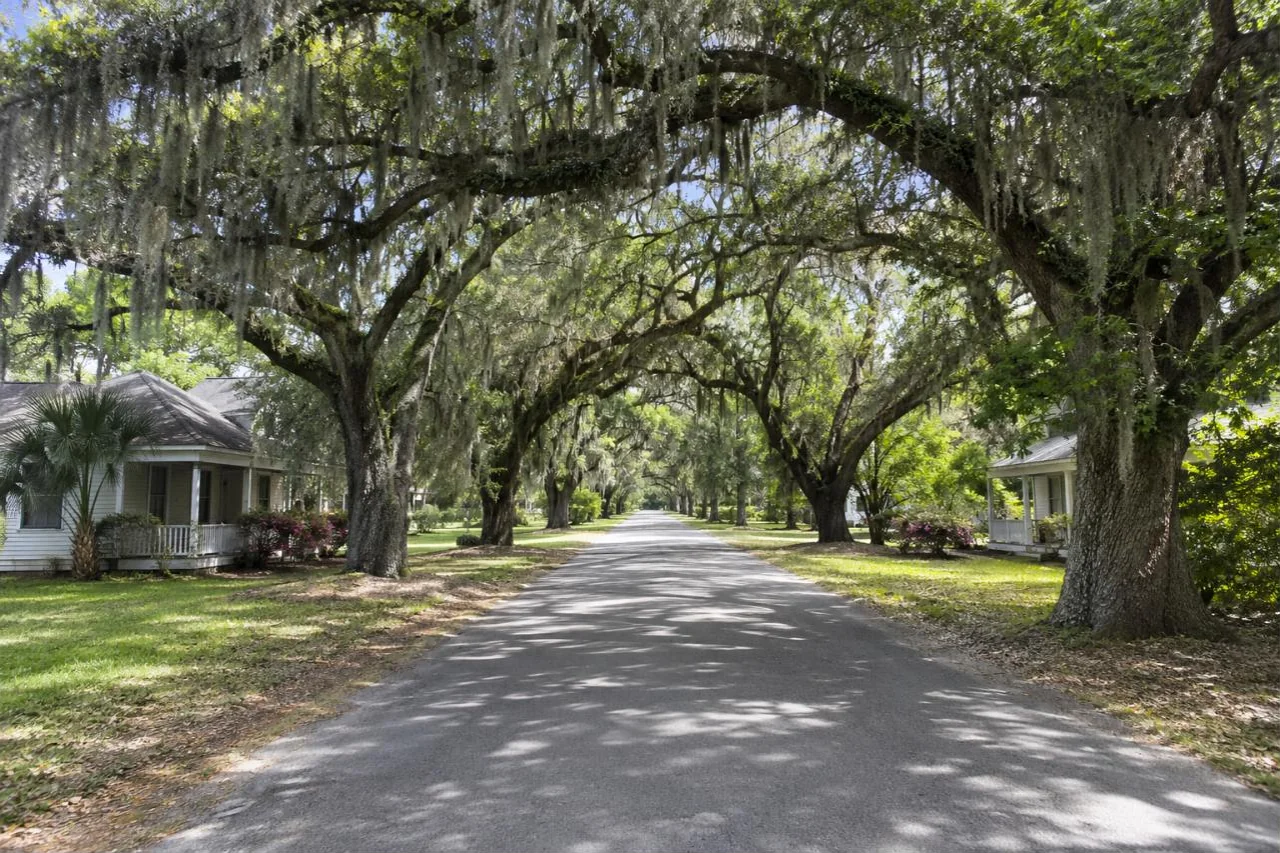
The 2023 ordinance added a canopy road. St. Johns Avenue from Forest Street to Clay Street is designated, and "All property within 20 feet of the outside right-of-way line" is its canopy tree protection zone. No person or agency may remove a tree inside that zone without a tree removal permit from the development services department (Sec. 113-274(c)). The home exemption is written as an exemption from the general rule in Sec. 113-275, while the canopy permit sits in a different section, so it appears to reach homes along that stretch too. How the city applies it to one- and two-family homes wasn't confirmed for this site: if your lot touches St. Johns Avenue in that stretch, ask before anyone cuts.
Trees an owner chose to protect
An owner can ask the city to designate "a particularly fine or unusual example of any tree" as protected, through an application, mailed notice to neighbors within 300 feet, a posted sign and a Planning and Zoning Commission hearing. If approved, a lien is recorded in the county records within 30 days at the owner's expense. It only binds lots whose owners asked for it.
Other city rules worth knowing
- Dangerous trees on property that isn't exempt. Sec. 113-276(3) lets the development services director give verbal authorization to remove a tree that "endangers health or safety and requires immediate removal," confirmed in writing afterward, and the tree can come down without a written permit once a certified arborist has made that determination.
- Street trees. Sec. 113-247(e)(6) says no "topping, hat racking, poodle cutting, excess pruning or excess crown reduction" on trees within the right-of-way.
- Replacement. Sec. 113-279 requires replacing trees over 12 inches DBH removed from a site, with separate schedules for live oaks, bald cypress and mature southern magnolias, or a payment to the city's tree mitigation fund. That applies to property that needs a permit, not to exempt homes.
- The application. It asks for the reason, a site drawing and a tree survey with the trees flagged. Neither the form nor the code text read for this site states a fee.
- Who to ask. Planning and Zoning: planning@greencovesprings.com or 904-297-7051; Planning Technician 904-297-7040; city offices, 321 Walnut Street.
Unincorporated Clay County: the 4-inch rule
Everything outside the four incorporated places follows Article VI of the Clay County Land Development Code, "Tree Protection and Landscaping Standards." The county's posted copy is headed "Reformatted 10/27/09, 08/23/16." An update of the code, begun in spring 2022, is still under staff review, and no newer adopted Article VI was found.
The core rule, Sec. 6-2(4)(a), makes it unlawful to remove, destroy or permanently injure "any existing four inch or larger in caliper tree without a landscape plan approved by the zoning director." Caliper means trunk diameter, measured 4.5 feet above the ground for existing trees.
Is your lot exempt?
Sec. 6-2(3) exempts, among others:
- "Single-family residential lots of record prior to January 28, 2003;"
- "Single-family residential lots that are not part of a major subdivision created after January 28, 2003;"
- a protected tree that poses imminent danger and needs removal without delay, with authorization from the public safety director in an emergency or the zoning director otherwise.
A major subdivision, under Sec. 6-1(3)(g), is "the subdivision of land into three or more residential lots" that required things like stormwater systems, new roads or utilities, or a right-of-way dedication. So the lots the rule reaches are in subdivisions of three or more lots, created after January 28, 2003, with that kind of infrastructure. Check your plat's recording date, and if it's later than that, call Zoning before removing anything 4 inches or bigger.
The rule covers Fleming Island, Oakleaf Plantation, Middleburg, Lake Asbury, Doctors Inlet, Lakeside and the unincorporated Orange Park area alike. Which named subdivisions fall after the 2003 line wasn't confirmed for this site, so none are listed here.
Specimen and historic trees
The Board of County Commissioners can also designate specimen or historic trees, which "shall be protected without regard to their location" in the county and need the Board's permission to remove, even on an otherwise exempt lot. In January 2023, for example, the county published notice of a hearing to designate an 83-inch live oak.
Penalties and fees
Under Sec. 6-10, a willful violation can bring a fine of up to $500 and up to 60 days in jail, and removed protected trees can be ordered replaced; the Code Enforcement Board can require replacement trees of at least 4-inch caliper. The code ties a landscape-plan fee to the size of the development site. Whether the amounts in the 2016 text are still charged wasn't confirmed, so ask Zoning for the current figure.
Clay County Zoning: (904) 278-4705, clay.zoning@claycountygov.com. The county's FAQ directs questions about land being cleared to DRC@claycountygov.com.
Town of Orange Park
The town's Economic and Community Development forms page lists a "Residential Tree Removal" application, separate from its commercial tree removal and landscape variance applications. The form asks: "Please submit photos of the trees(s) your are requesting to remove with your completed application." It can go in through the town's online permit portal, by email to ECD@townop.com, or in person at Town Hall, 2042 Park Avenue.
The town's code and the application itself couldn't be opened for this site, so which trees need the application, the size threshold, any fee and any replanting rule aren't stated here. Economic and Community Development: (904) 264-2635.
Keystone Heights and Penney Farms
Keystone Heights' Environmental Preservation article (Secs. 17-219 to 17-227, adopted July 24, 2013), read from a third-party copy of the code, exempts "Removal of trees on lots zoned for one and two family dwellings that are less than ten acres in size on July 1, 2013." Other property needs a Level I permit to remove a tree over 4 inches DBH, even a dead or diseased one, with one tree planted for each removed; emergency removals call for photos and notice to the city within ten days. Confirm with the city, since the official code wasn't opened.
No tree ordinance for the Town of Penney Farms turned up. That doesn't mean there isn't one; ask Town Hall before a tree comes down.
Florida's hazard-tree law, section 163.045
Since 2019, and amended in 2022, Florida Statute 163.045 has given owners of single-family homes a path around local tree rules for risky trees. In the 2026 text:
- Whose property. "Residential property" means a detached single-family building on a lot actively used for single-family purposes, as a conforming or legally recognized nonconforming use.
- What the owner needs. "Documentation": an on-site assessment following Best Management Practices – Tree Risk Assessment, Second Edition (2017), done and signed by an arborist certified by the International Society of Arboriculture or by a Florida landscape architect.
- What it has to show. That the tree poses an "unacceptable risk": its risk can't practically be brought below moderate except by taking the tree out.
- What the local government then can't demand. Any notice, application, approval, permit, fee or mitigation for pruning, trimming or removing that tree, and any replanting afterward.
- The carve-out. It doesn't apply to delegated mangrove protection authority.
Two gaps to keep in mind. The statute talks about "a local government" only, so a homeowners association's covenants or architectural review still apply. And the words "canopy road" don't appear in it; whether it overrides Green Cove Springs' St. Johns Avenue permit for a single-family home is a legal question this site can't answer, so ask the city. The documentation is the owner's, arranged before the tree comes down.
Trees along roads and in utility easements
State highways. Florida Statute 337.405 prohibits removing or cutting trees in the State Highway System's right-of-way without prior written permission from the Department of Transportation, except normal trimming needed for safe operation of utility lines. A violation is a second-degree misdemeanor. If a tree is down across any road and blocking it, call 911.
County roads. Clay County Public Works, 5 Esplanade Avenue in Green Cove Springs, maintains county roadways: 904-284-6335, weekdays 7 a.m. to 3:30 p.m. Whether the county requires a right-of-way permit for private tree work wasn't confirmed; ask Public Works before cutting a tree on the road side of your lot line.
City streets in Green Cove Springs. Report street problems to Public Works at 904-297-7500, ext. 2213. During storms the city also takes reports of downed trees and outages by text: send "Hi" to 904-560-5116. The topping ban above applies to right-of-way trees.
Utility rights-of-way. Under Florida Statute 163.3209, a local government can't require permits for a utility's vegetation work, including tree removal, in an established electric right-of-way, and can't require planting anything there that will grow taller than 14 feet.
Burning limbs and brush
Florida separates a homeowner's yard waste from a tree company's cutting debris.
- A homeowner's yard waste. The Department of Environmental Protection's open burning page says authorization from the Florida Forest Service isn't required for burning residential yard waste, though checking burn conditions with the Forest Service is recommended. The pile must be no greater than 8 feet across or in a noncombustible container, lit after 9 a.m. Eastern and out one hour before sunset, kept 150 feet from occupied buildings other than the landowner's, 50 feet from any paved public road and 25 feet from wildlands, brush or combustible structures, attended with fire extinguishing equipment ready, and not in windy conditions. Treated wood, plastics, tires, garbage and trash are prohibited.
- Tree-cutting debris. Florida Statute 590.125 defines burning tree-cutting debris that originates on site as pile burning. Forest Service Rule 5I-2.006(5) requires an air curtain incinerator unless the debris came from a home of no more than two family units, is burned where it was cut, and follows the pile-burning rules: Forest Service authorization, 300 feet from occupied buildings other than the landowner's, 100 feet from a paved public road, 50 feet from wildlands, brush or combustible structures, and constant attendance.
- Counties and towns can ban it. DEP notes that "Counties and municipalities may prohibit these types of open burning."
Orange Park
"Open burning is not allowed in the Town limits." Town Code Sec. 22-1(a) bars burning underbrush, trash or rubbish without the fire chief's authorization; fire pits, outdoor fireplaces and chimineas are allowed. Orange Park Fire Department: (904) 264-3411.
The 2026 burn ban in unincorporated Clay County
Spring 2026 was dry. On February 20 the county reported that commissioners had discussed a countywide residential burn ban during cold and drought conditions. On April 16, 2026 the county announced a burn ban in unincorporated Clay County under a local state of emergency: "no campfires, no burning yard debris, or any other outdoor burning of any kind," with violations a second-degree misdemeanor, and Forest Service-authorized burns still allowed. Days later, on April 22, FEMA approved fire management assistance for the Railroad Complex Fire, which began April 19 and named Clay County. Jax Today reported on June 1, 2026 that the county had lifted the ban after rain eased the drought.
Whether a ban is in force when you read this isn't something a static page can tell you. Check Clay County's announcements and the Florida Forest Service before burning anything.
Curbside limits and drop-off
| Service area | Rules for tree debris at the curb | Phone |
|---|---|---|
| Unincorporated Clay County | Yard waste collected weekly; limbs cut to 5-foot lengths, 50 pounds at most, stacked neatly, at the curb by 6 a.m. | Environmental Services, 904-284-6374 |
| City of Green Cove Springs | Yard trash bagged, up to 20 bags; limbs no larger than 4 inches across and 4 feet long, in a stack no bigger than 3 by 3 by 6 feet; keep it separate from garbage | Bulky items, 904-297-7500, option 3 |
| Town of Orange Park | Pickup Tuesday or Wednesday by map; loose limbs, trunks and stumps no longer than 5 feet or thicker than 6 inches; up to 5 cubic yards per service day | Waste Management, (904) 695-0500 |
County residents can also bring loads to the Environmental Convenience Centers and the Rosemary Hill Solid Waste Facility within the limits on the county's bulk waste page. After a hurricane, the county's storm debris rules take over; see the storm guide. Grinding the stump afterward needs a Sunshine 811 notice two full business days ahead; see stump grinding.
Permit questions people ask in Clay County
Is a permit needed to remove a dead tree?
Inside Green Cove Springs, not for a one- or two-family home outside the canopy zone. In the unincorporated county, a dead tree on a post-2003 major-subdivision lot still falls under the 4-inch rule unless an exemption applies, so ask Zoning; the state law is another route if the tree is a documented risk. In Keystone Heights, the code says a permit is needed even for dead or diseased trees on non-exempt property.
How is the 4 inches measured?
Across the trunk, 4.5 feet above the ground, not around it. A trunk 4 inches across is about 12.5 inches around.
Does pruning need a permit?
Not as a rule, but cutting can count as removal. Green Cove Springs' general rule covers "effectively destroy through damaging any tree," and its code bars topping and excess crown reduction on right-of-way trees. The county rule covers permanently injuring a tree, not just removing it. Florida Statute 163.045 covers pruning and trimming as well as removal for qualifying risky trees. See tree trimming.
Requests from this site are handed to a single independent contractor in Clay County. Rules, approvals and burn decisions come only from the city, town, county and state offices named here.
Sources checked for this page
- City of Green Cove Springs Land Development Code, Chapter 113, Articles VI and VII, as amended by Ord. O-23-2023 (adopted Sept 5, 2023): the city's ordinance file, checked against the codified text in the Zoneomics copy; the official code is on Municode, linked from the city's Planning and Zoning page. City Tree Removal Application and Planning and Zoning. Checked Nov 12, 2026.
- Clay County Land Development Code, Article VI; LDC update page; Planning and Zoning FAQ; Clay Today legal notice, Jan 12, 2023. Checked Nov 12, 2026.
- Town of Orange Park, ECD forms and applications, building and permitting, burning in the town limits and garbage and yard waste. Checked Nov 12, 2026.
- City of Keystone Heights code, Article XX, Zoneomics copy. Checked Nov 12, 2026.
- Florida Statutes (2026): 163.045, 163.3209, 337.405, 556.105 and 556.108 and 590.125. Checked Nov 12, 2026.
- Florida DEP, Open Burning; Rules 62-256.700 and 5I-2.006, F.A.C. (5I-2.006 text). Checked Nov 12, 2026.
- Clay County news releases of Feb 20, 2026 and Apr 16, 2026; Jax Today, burn ban ends, Jun 1, 2026; OpenFEMA declaration FM-5631. Checked Nov 12, 2026.
- Clay County Public Works, garbage and recycling, bulk waste and Oct 18, 2024 bulletin; Green Cove Springs Street Maintenance, hurricane preparedness, yard waste and pickup information. Checked Nov 12, 2026.