
Laurel oak and live oak, trait by trait
Both can grow big enough to shade a whole house. Here is what the extension and Forest Service sources say about each, checked Nov 12, 2026:
| Laurel oak | Live oak | |
|---|---|---|
| Shape | "Taller than they are broad," reaching 60 feet or more with a 35- to 45-foot spread (UF/IFAS) | "Never attains great height," but the crown can span 150 feet or more (USDA Forest Service) |
| Life span | 50 to 70 years (UF/IFAS); "usually matures in about 50 years" (USDA) | Longer: UF/IFAS says live oak and other oaks "are more resistant to decay and live longer" |
| Growth | Fast; a "rapid-growing short-lived tree of the moist woods" (USDA) | "Fast-growing and easily transplanted when young" (USDA) |
| Wood | Trunk and main limbs often hollowed by decay and wood rot; rated "susceptible to breakage" (UF/IFAS) | More resistant to decay (UF/IFAS) |
| Hurricanes | Lowest wind-resistance group for north Florida; "poorer overall survival than both live oak and sand live oak" (UF/IFAS FR173) | USDA notes its "ability... to grow and mature on sites subject to hurricane-force winds" |
| Where it grows | "Most common on alluvial flood plains," often "in sandy soil near rivers and along the edges of swamps" (USDA); tolerant of wet sites (UF/IFAS) | Resists salt spray and salty soil (USDA) |
| Fire and cold | "Frequently killed by even light ground fires"; heart rots common in trees that burn occasionally (USDA) | Young trees highly susceptible to fire; also susceptible to freeze damage (USDA) |
| Diseases named | Shoestring root rot, which "attacks the roots and once inside moves upward, killing the cambium" (UF/IFAS) | Leaf blister defoliation; Spanish moss "may damage trees" (USDA) |
How to tell which one you have
Start with the shape of the whole tree. A laurel oak tends to be upright, taller than it is wide, with a crown that tops out around 35 to 45 feet across. A mature live oak goes the other way: long limbs reaching far out to the sides, with a crown that can end up much wider than the tree is tall.
Then think about where and how it was planted. UF/IFAS lists laurel oak for shade, parking-lot islands of more than 200 square feet, tree lawns over 6 feet wide and highway medians, and USDA notes it's planted in the South as an ornamental. In the wild it favors flood plains and the edges of swamps, so trees along the St. Johns River, Black Creek and the lower ground near them are worth a closer look.
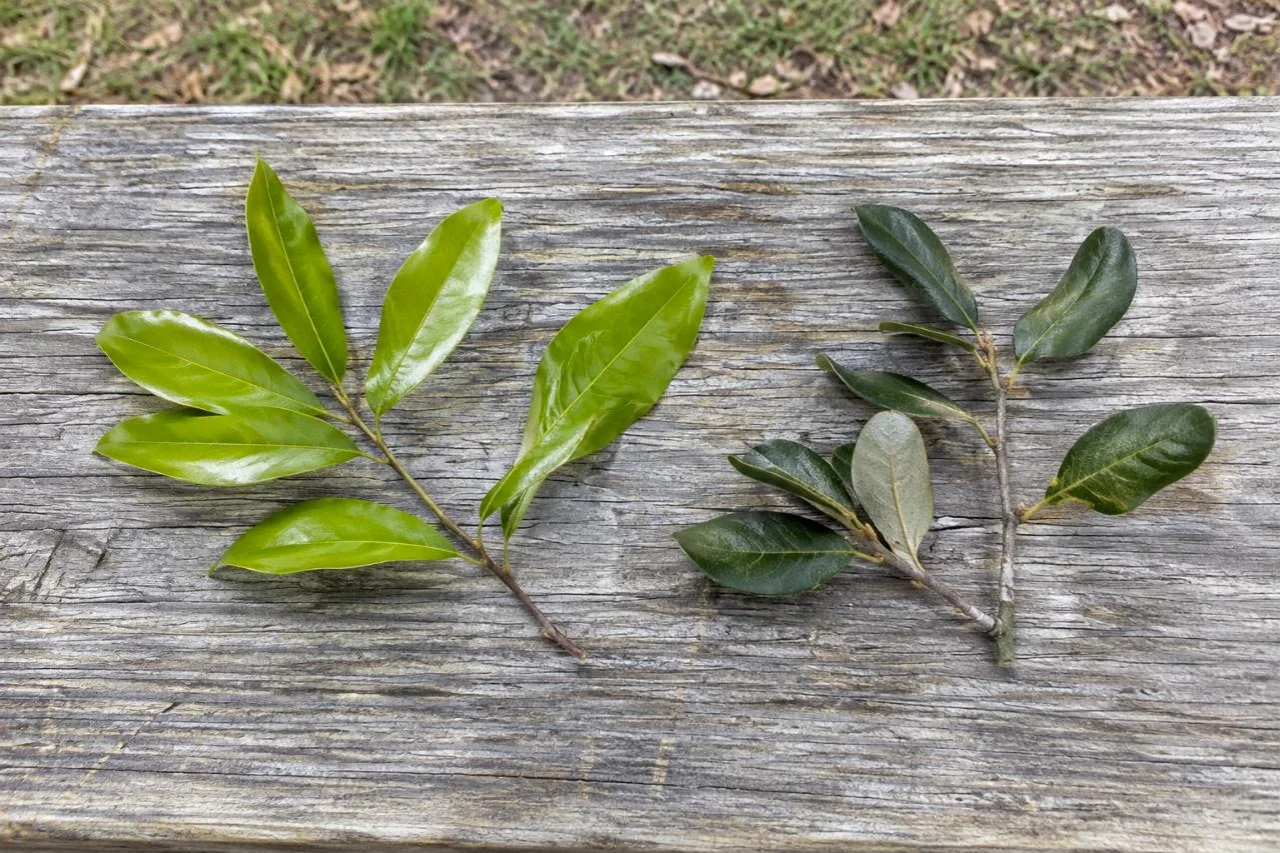
Leaves help too, but don't decide from a single twig. If the form of the tree doesn't settle it, ask the contractor to confirm which oak it is before you decide anything. It matters, because the two species age, decay and weather storms so differently.
Hollow trunks and fungus
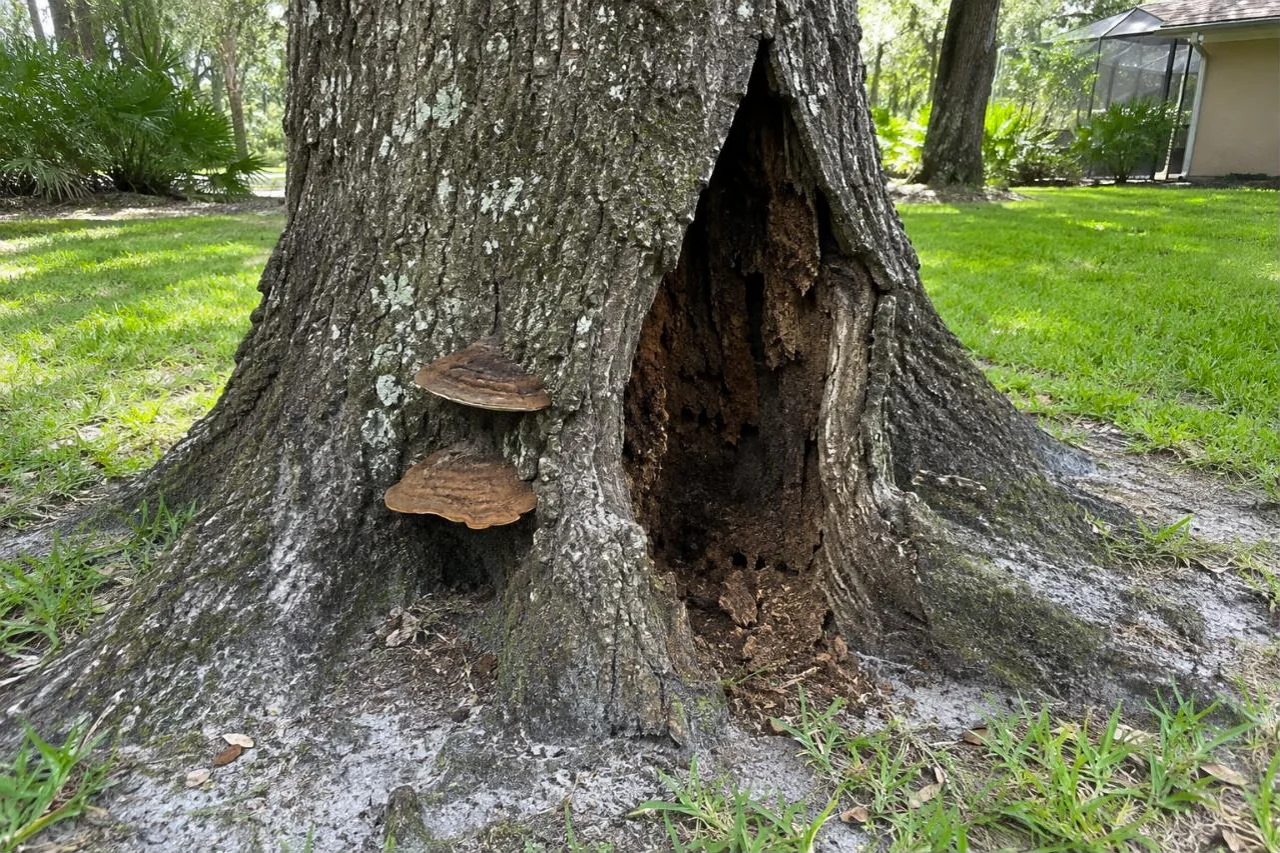
UF/IFAS is blunt about laurel oak wood: "The smallest trunk injury or improper pruning cut can result in columns of decay inside the trunk." Over decades, those columns can join into the dark cavity you see at the base of an old trunk. The FR173 hurricane paper explains why that matters: "Decay, a major cause of tree failure, is caused by fungi that weaken wood," and "Old trees with decayed root systems, stem decay, or large dead branches are vulnerable to hurricanes."
Things worth pointing out to the contractor on a laurel oak:
- An opening or soft, crumbling wood at the base or where a big limb was once cut off.
- Shelf-like fungus growing on the trunk or root flare.
- Large dead limbs in the crown, especially over the roof or a pool enclosure.
- Any old fire scar. USDA notes heart rots are common in laurel oaks that have been through occasional burns.
A cavity alone doesn't always mean a tree will fail tomorrow, and how much sound wood remains is something only a close look can judge. But a hollow, mature laurel oak beside a house is exactly the kind of tree the UF/IFAS paper singles out.
How laurel oaks come through hurricanes
UF/IFAS studied which trees survived Florida hurricanes and grouped species by wind resistance. Its paper names laurel oak, water oak, pecan and sand pine as the north Florida species in the lowest group, and says that is a particular worry when trees "are over-mature, endangering lives and property" (checked Nov 12, 2026). In the same research, "laurel oak had poorer overall survival than both live oak and sand live oak."
Clay County has seen what wind and water do together. In Hurricane Irma in 2017, the National Weather Service in Jacksonville reported widespread wind damage across the county with trees and power lines down, and historic flooding on the St. Johns River and Black Creek. Because laurel oak favors flood plains, the ones growing on low ground near the creek and the river stand where water collects in a storm like that. On upland sand, by contrast, USDA says it develops "a large well-defined taproot."
The 50-year question
A laurel oak's expected life is 50 to 70 years by UF/IFAS's count, and USDA says it usually matures in about 50. A laurel oak planted when a house was built is about as old as the house, so one planted beside a house finished in 1976 turned 50 this year. If yours was there when you bought the house, the age of the neighborhood is a rough first clue to the age of the tree.
Rules for taking one down
None of Clay County's local codes read for this site singles out laurel oak, so the general rules for your address apply (checked Nov 12, 2026):
- Green Cove Springs. No city permit for a one- or two-family home, except in the St. Johns Avenue canopy zone or for an owner-designated protected tree. The city's replacement schedules treat live oaks separately, but those apply to property that needs a permit, not exempt homes.
- Unincorporated Clay County. On a lot in a major subdivision created after January 28, 2003, removing a laurel oak 4 inches or more across needs a landscape plan approved by the zoning director, unless an exemption applies. Zoning: (904) 278-4705.
- Orange Park. The town has a Residential Tree Removal application that asks for photos of each tree.
- State law. Under Florida Statute 163.045, an owner holding a tree risk assessment showing unacceptable risk, signed by an arborist certified by the International Society of Arboriculture or by a Florida landscape architect, can't be required to get a local permit, pay a fee or replant.
The full picture, with the exceptions, is in the Clay County tree rules guide.
If you keep it: pruning that doesn't invite rot
Because a careless cut can start a column of decay, how a laurel oak is pruned matters more than with most trees. UF/IFAS advises developing "a strong branch structure with major branches well-spaced along the trunk," spaced "two to three feet apart." That's easiest on a young tree; on an old one, the goal is removing dead and hazardous limbs with clean cuts and as few large wounds as possible. Keep trucks and trenching off the roots under the canopy, and keep burn piles well away, since USDA calls fire "especially hazardous to laurel oaks." The trimming guide covers more.
Planting something in its place
Live oak is the obvious alternative in the sources: longer-lived, more decay-resistant and a better hurricane survivor in UF/IFAS research. It needs room, though, with a crown that can eventually span 150 feet. Clay Electric's "Keeping the Lines Clear" brochure doesn't recommend planting trees in its right-of-way and suggests keeping small trees at least 15 feet from power lines, medium trees 35 feet and large trees 45 feet (checked Nov 12, 2026). Clay County's code prohibits planting several species, including mimosa, paper mulberry, camphor, chinaberry and Chinese tallow.
What removing a laurel oak costs
HomeGuide puts oak removal at $250 to $2,500 nationally, and its height tiers run from $650 to $2,000 for trees 60 to 80 feet tall (checked Nov 12, 2026). Those are national numbers. A hollow trunk that a climber can't trust may call for a bucket truck or a crane, which HomeGuide lists at $500 to $2,500 per day extra, and hauling a big trunk adds to the bill. The price page has every figure with its source.
Laurel oak questions
Is every old laurel oak dangerous?
No. The sources describe a species that tends to decay and break as it ages, not a deadline for every tree. A sound laurel oak well away from the house may be fine for years. A hollow one leaning over the roof is another matter.
Can I remove a laurel oak in Fleming Island without a permit?
It depends on your lot. Fleming Island is unincorporated, so the county's rule applies: lots of record before January 28, 2003, and lots outside a major subdivision created after that date, are exempt. On a post-2003 major-subdivision lot, a landscape plan approved by Clay County Zoning comes first (checked Nov 12, 2026).
Why did my laurel oak lose big limbs when the live oak next to it didn't?
UF/IFAS rates laurel oak "susceptible to breakage" and found it survived hurricanes less well than live oak. It also notes that hollowing from decay is common in laurel oak trunks and big limbs, and that it can begin at a small wound or a poor pruning cut.
Does the stump need grinding?
Only if you want the spot usable. If you do, Sunshine 811 needs two full business days' notice first. See stump grinding.
Laurel oak requests from this site are passed to one independent contractor serving Clay County. The site doesn't inspect or remove trees.
Sources checked for this page
- UF/IFAS EDIS, Quercus laurifolia: Laurel Oak (ENH-707, revised Dec 2018). Checked Nov 12, 2026.
- UF/IFAS EDIS, Wind and Trees: Lessons Learned from Hurricanes (FR173). Checked Nov 12, 2026.
- Silvics of North America (USDA Forest Service, Agriculture Handbook 654): laurel oak and live oak. Checked Nov 12, 2026.
- NWS Jacksonville Irma report, reprinted in the Florida Climate Center's Irma summary. Checked Nov 12, 2026.
- City of Green Cove Springs LDC Chapter 113, Article VII (city ordinance file and Zoneomics copy); Clay County LDC Article VI; Town of Orange Park forms; Fla. Stat. 163.045. Checked Nov 12, 2026.
- Clay Electric Cooperative, Keeping the Lines Clear (Feb 2017); HomeGuide, tree removal cost. Checked Nov 12, 2026.