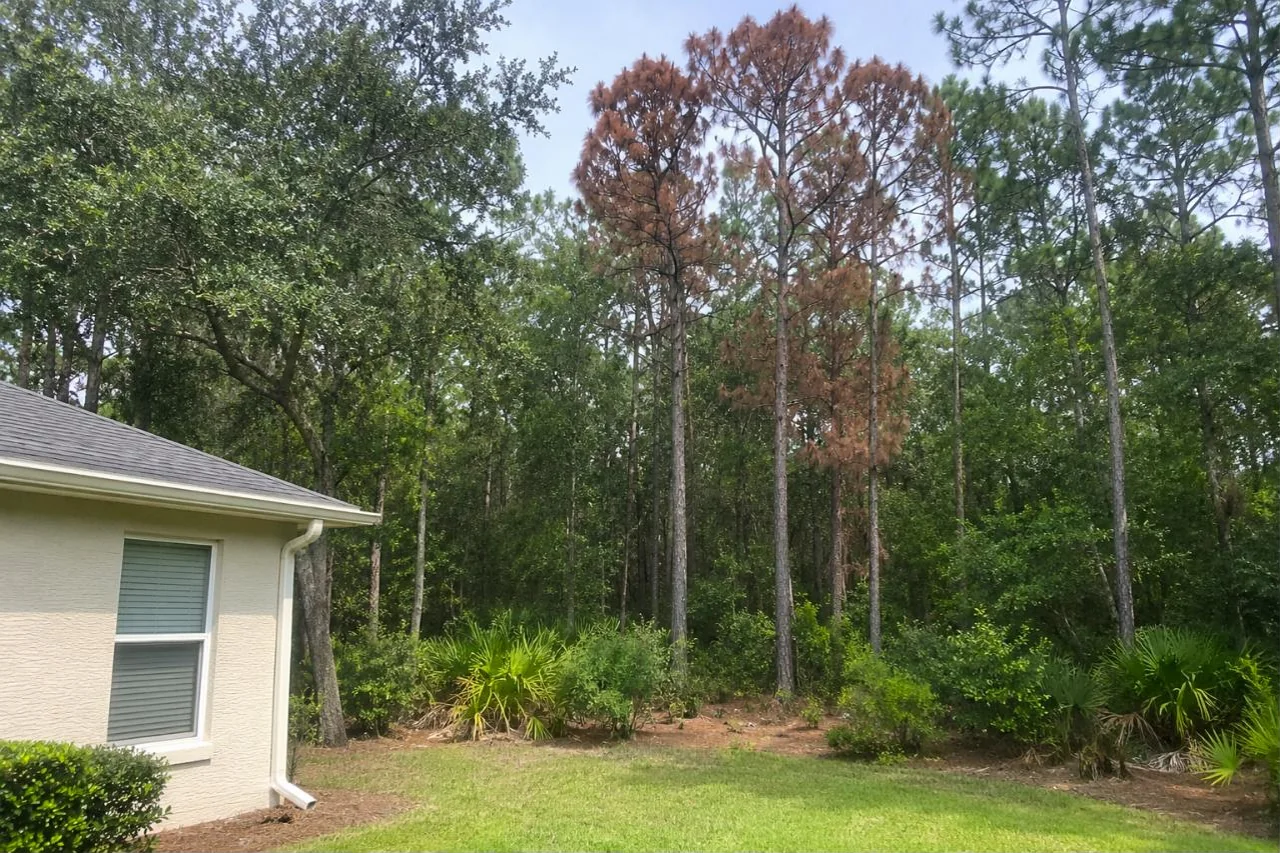
Pines going brown after the 2026 drought
Clay Electric's August 5, 2026 notice, "Dry conditions weaken trees near power lines," is the plainest local warning. It says: "Prolonged dry conditions have weakened trees across Clay Electric's service area, especially pine trees," and "Drought also limits resin production, weakening a tree's natural defense against bark beetles" (checked Nov 12, 2026). Resin is part of a pine's defense against bark beetles, so a pine that went short of water in this year's dry spell may have been easier for them to get into.
Southern pine beetle: the fast one
UF/IFAS's southern pine beetle publication (checked Nov 12, 2026) describes a beetle that is "common in north Florida" and "can infest and kill any species of pine within its distribution." Clay County is well inside that range. What it says to look for:
- "Numerous popcorn-size lumps of pitch" on the bark, "almost always in crevices, rather than on bark plates."
- Crowns that "change color from green to yellow to red before turning brown."
- Under loose bark, galleries with a distinctive "zig-zag to 's' shape."
The same publication is stark about what follows: "Once SPB has successfully colonized a tree, the tree cannot survive, regardless of control measures." Infested spots "may expand at rates up to 15 m (50 ft.)/day," and the beetles can overcome nearby healthy trees "via mass attacks over a period of a few weeks." Outbreaks "often originate in injured trees, typically after a lightning strike," and UF/IFAS advises to "Remove severely damaged pines rapidly." Its recommended response to an outbreak is to remove and process the infested pines.
For perspective, the same source says Florida "has not experienced many destructive SPB episodes," with "only a localized resurgence" from 2016 through 2018 and little activity in the years after. It also notes that drought-stressed pines are rarely the ones southern pine beetle colonizes.
Engraver beetles and black turpentine beetle
Florida's more common pine beetles are three Ips engraver species and the black turpentine beetle, which UF/IFAS calls "less aggressive but more common." The USDA Forest Service says lightning is perhaps the greatest single cause of death in pole- and sawlog-size longleaf pines, "often followed by infestation by bark beetles (Ips spp.)," and that black turpentine beetle and Ips "can become problems" in slash pine. Slash pine's most serious disease is fusiform rust, and annosus root rot is another (checked Nov 12, 2026).
Whichever beetle it is, a pine whose whole crown has gone brown is dying or dead, and Clay Electric counts dead trees among those that can fall onto lines. The trees page has more on Clay County's pines.
Oaks with hollow trunks or dead limbs
With oaks, the warning signs in the sources are mostly about decay. UF/IFAS says laurel oak trunks and big limbs commonly hollow out from decay and wood rot, and that even a small wound or a poorly made pruning cut can let a column of decay begin. The USDA Forest Service notes water oak is subject to "trunk canker and heart rot," and that trees surviving a fire are "extremely susceptible to butt rot." The UF/IFAS hurricane paper adds that "Old trees with decayed root systems, stem decay, or large dead branches are vulnerable to hurricanes" (all checked Nov 12, 2026).
Signs worth showing the contractor: an open cavity at the base or at an old pruning cut, shelf fungus on the trunk or root flare, and large dead limbs, especially over the roof. The laurel oak guide goes deeper on the oak most prone to this.
A conk on a palm trunk
For palms, UF/IFAS's guide to Ganoderma butt rot (checked Nov 12, 2026) is short and unforgiving:
- "All palms are assumed to be susceptible to this disease," and the guide pictures a cabbage palm with it.
- "The disease is confirmed prior to palm death by observing the basidiocarp (conk) on the trunk."
- "There are currently no cultural or chemical controls for preventing the disease."
- "A palm should be removed as soon as possible after the conks appear on the trunk," with as much of the stump and root system removed as possible, or the stump ground out.
- Replanting: "planting another palm back in that same location is not recommended without special precautions."
That makes a conked palm a removal-plus-stump job, which is worth saying when you send the request. See stump grinding.
Reading a lean
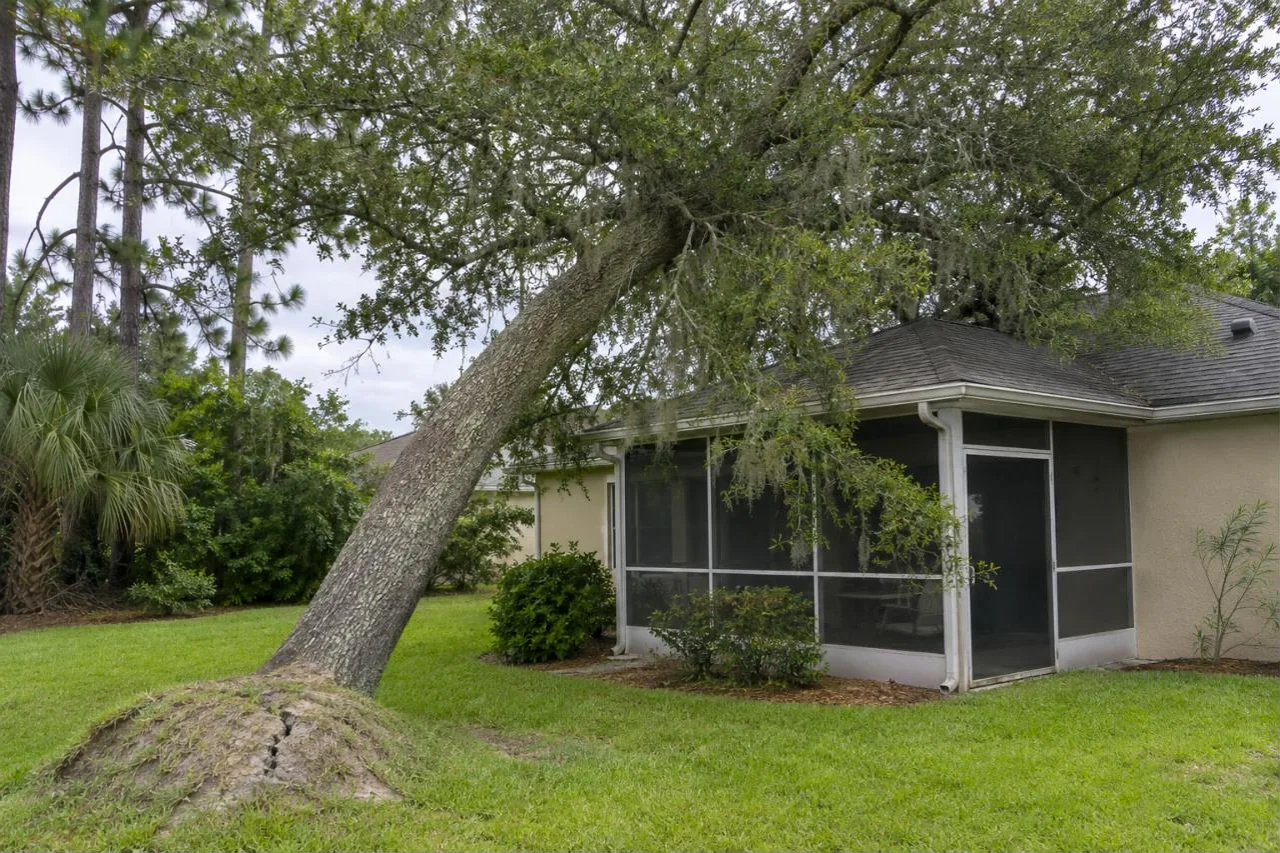
Plenty of trees grow with a lean and stand for decades. What matters is change. A tree that has started leaning further, especially after a storm or heavy rain, with the ground mounded or split open on the side away from the lean, may have roots that are pulling loose.
The sources point to why some trees here are prone to it (checked Nov 12, 2026): USDA calls water oak's rooting habit "shallow, spreading" and says slash pine "is subject to windthrow on shallow soils." The UF/IFAS hurricane paper warns that "When roots under the canopy are cut, trees are more predisposed to falling over," so a lean that appears after a new driveway, pool or utility trench is a red flag. Clay Electric lists "severely leaning trees" among those that can fall onto lines.
If a tree has started to move toward the house, keep people out of the rooms on that side and off that part of the yard until someone has looked at it. If it's leaning into a power line, call the utility rather than anyone with a saw.
Dead or leaning trees near power lines
Clay Electric "inspects each circuit on a yearly cycle for hazardous trees and conditions" and re-clears lines on a three-year cycle in the city, four in urban areas and five in rural areas. It "will cut danger trees that are adjacent to our power lines along the edge of the right-of-way," and its August 2026 notice says that when such a tree threatens a line, it "may remove it or reduce its height." But it also says it "does not clean up, remove or haul away wood or debris from dead or hazardous trees," and a tree away from its right-of-way is the owner's (all checked Nov 12, 2026).
For a tree you think threatens a Clay Electric line, call 1-800-511-5998 or email vegmgt@ClayElectric.com. In the City of Green Cove Springs' service area, the Electric Department's number is 904-297-7094. Whatever the utility, if a line is down or arcing, call 911.
What the rules allow for hazard trees
- Green Cove Springs. One- and two-family homes don't need a city permit to begin with, outside the St. Johns Avenue canopy zone and owner-designated protected trees. For other property, the code lets the development services director give verbal authorization to remove a tree that "endangers health or safety and requires immediate removal," confirmed in writing afterward, and the tree can come down without a written permit once a certified arborist has made that determination.
- Unincorporated Clay County. On lots the 4-inch rule reaches, the code exempts a protected tree "that poses imminent danger" and requires removal without delay, with authorization from the public safety director in an emergency or the zoning director otherwise. Zoning: (904) 278-4705.
- Keystone Heights. On non-exempt property, its code requires a Level I permit even for dead or diseased trees; emergency removals need photos and notice to the city within ten days.
- Anywhere, for a single-family home. Florida Statute 163.045 bars local permits, fees and replanting requirements when the owner holds a tree risk assessment showing the tree is an unacceptable risk, signed by an arborist certified by the International Society of Arboriculture or by a Florida landscape architect.
All checked Nov 12, 2026. The rules guide has the details and contacts.
Signs and what the sources say about them
| What you see | What it can mean |
|---|---|
| Pine crown going yellow, then red, then brown | Southern pine beetle, Ips or another cause has killed the tree; with SPB, UF/IFAS says a colonized tree can't survive |
| Popcorn-size pitch lumps in bark crevices | A sign of southern pine beetle attack (UF/IFAS) |
| Pine hit by lightning | Bark beetles often follow; UF/IFAS advises removing severely damaged pines rapidly |
| Hollow base or trunk on an oak | Decay, which the UF/IFAS hurricane paper calls a major cause of tree failure |
| Shelf-like conk on a palm trunk | Ganoderma butt rot; UF/IFAS says remove the palm as soon as possible |
| Lean increasing, soil heaved or cracked at the base | Roots may be letting go; shallow-rooted species and cut roots raise the risk |
Dying and leaning tree questions
Can a dead pine be left standing if it's far from the house?
That's your call if it can't hit anything when it falls. Southern pine beetle is the reason to think twice: UF/IFAS describes infestations spreading to nearby healthy pines and recommends removing infested trees. If the brown pine is one of several dying in a group, mention that in your request.
Will Clay Electric take down a dead tree in my yard?
Only a danger tree beside its lines at the edge of its right-of-way, and even then it doesn't haul the wood away. Call 1-800-511-5998 to ask about a specific tree (checked Nov 12, 2026).
Is help available from the Florida Forest Service for pine beetles?
UF/IFAS describes a Forest Service Southern Pine Beetle Assistance and Prevention Program limited to 44 northern Florida counties. Whether Clay County is one of them and whether the program is open now wasn't confirmed for this site, so ask the Forest Service directly.
My oak has fungus at the base. Does it have to come down?
Not automatically. Fungus means decay, and how much sound wood is left decides it. Point it out to the contractor, along with any lean or dead limbs, and ask how much of the trunk is affected.
Ask about a failing tree here and the details reach one independent Clay County contractor, who looks at it in person. The site doesn't inspect trees or give risk assessments.
Sources checked for this page
- Clay Electric Cooperative, "Dry conditions weaken trees near power lines" (Aug 5, 2026) and vegetation management; City of Green Cove Springs, Report Outages. Checked Nov 12, 2026.
- UF/IFAS, The Southern Pine Beetle, Dendroctonus frontalis (EENY-176), Ganoderma Butt Rot of Palms, Laurel Oak and Wind and Trees. Checked Nov 12, 2026.
- Silvics of North America (USDA Forest Service, Agriculture Handbook 654): longleaf pine, slash pine and water oak. Checked Nov 12, 2026.
- City of Green Cove Springs LDC Chapter 113 (city ordinance file and Zoneomics copy); Clay County LDC Article VI; Keystone Heights code (Zoneomics copy); Fla. Stat. 163.045. Checked Nov 12, 2026.