
Check the address before the saw comes out
Clay County has several sets of local tree rules, and which one you live under depends on the city or town line, not the mailing address. A house with an Orange Park mailing address can sit outside the town limits and follow the county code instead. Here is the short version, all checked Nov 12, 2026; the rules guide has the full text and the exceptions.
| Where the house is | Removing a tree on your own home lot | Who to ask |
|---|---|---|
| City of Green Cove Springs | No city permit for one- and two-family homes, except in the St. Johns Avenue canopy zone or for a tree the owner has had designated protected | Planning, 904-297-7051 or planning@greencovesprings.com |
| Unincorporated Clay County | Exempt if the lot existed before Jan 28, 2003 or isn't in a major subdivision created after that date; otherwise a tree 4 inches or more across needs a landscape plan approved by the zoning director | Clay County Zoning, (904) 278-4705 |
| Town of Orange Park | The town posts a Residential Tree Removal application and wants photos of each tree; size rules not confirmed here | Economic and Community Development, (904) 264-2635 |
| City of Keystone Heights | Exempt for lots zoned for one- and two-family homes that were under 10 acres on July 1, 2013 | The city |
| Town of Penney Farms | No tree ordinance was found for this site | Town Hall, before cutting |
Two more things apply everywhere. Florida Statute 163.045 lets the owner of a single-family home prune or remove a tree without any local notice, permit, fee or replanting if the owner holds an on-site tree risk assessment showing the tree is an unacceptable risk, signed by an arborist certified by the International Society of Arboriculture or by a Florida landscape architect (checked Nov 12, 2026). And a homeowners association is a separate matter: the statute speaks only to local governments, so read your association's rules as well.
How a big tree comes down next to a house
Dropping a tree whole, with a notch on the side it should fall toward and a back cut opposite, only works when there's clear ground in that direction longer than the tree is tall. On many house lots, with the house on one side, a screened pool enclosure on another and a fence and the neighbor's roof behind, that space rarely exists. So most removals near houses are done in sections:
- Limbs first. The crown is taken apart branch by branch, by a climber or from a bucket truck. Pieces hanging over a roof or an enclosure get roped and let down slowly instead of being dropped.
- Then the trunk, in lengths. Once the limbs are off, the trunk comes down a few feet at a time until what's left can be felled into open lawn.
- A crane, when nothing else can reach. If a bucket truck can't get close and the tree is too weak or too awkward to climb, a crane lifts sections over the house. HomeGuide lists crane-assisted removal at $500 to $2,500 per day on top of the job (checked Nov 12, 2026).
The trees themselves explain why this is slow work here. UF/IFAS describes laurel oak as reaching 60 feet or more with a 35- to 45-foot spread, and the USDA Forest Service says a live oak's crown can span 150 feet or more even though the tree never gets especially tall (both checked Nov 12, 2026). A wide oak spreads its weight over a roof and a pool enclosure at the same time, and every one of those limbs has to come down under control.
Hollow or decayed wood changes the plan. UF/IFAS warns that a laurel oak's trunk and main limbs are often hollowed by decay and wood rot, and a climber can't safely tie into wood that won't hold. When a tree is too far gone to climb, a bucket truck or crane is the usual answer. The laurel oak guide covers what to look for.
Gray sand, soft ground and creek bottoms
Much of what grows here grows in sand. The Penney soil series, whose type location is in Clay County, is described by the USDA as "very deep, excessively drained, rapidly permeable soils on uplands," and the series is extensive in northeast Florida (checked Nov 12, 2026). Ground like that drains and dries out fast, which matters in a dry year like 2026, when Clay Electric said drought had weakened pines in particular; see dead or leaning trees.
Lower ground is different. The USDA Forest Service says laurel oak is "most common on alluvial flood plains" and most often found "in sandy soil near rivers and along the edges of swamps." Lots near the St. Johns River, Black Creek and their tributaries can stay soft for days after heavy rain. During Hurricane Irma, Weather Service stations near Orange Park, Middleburg and Green Cove Springs recorded 10.48 to 11.32 inches over September 11 and 12, 2017 (checked Nov 12, 2026). A loaded truck on ground like that can rut a lawn and crush roots.
That matters for the trees you keep. A UF/IFAS hurricane paper notes that "when roots under the canopy are cut, trees are more predisposed to falling over" (checked Nov 12, 2026). Clay County's code, for construction sites, protects a root zone of one foot of radius for each inch of trunk diameter around trees that are meant to stay. At a house, it's worth asking the contractor where the truck, chipper and log piles will sit, and keeping them off the root zones of the oaks you want to keep.
Service wires and power lines
Four electric utilities serve parts of Clay County. In an October 2024 Florida Public Service Commission report, Clay Electric Cooperative had 91,399 of the county's 101,600 accounts, Green Cove Springs Electric 4,781, JEA 4,470 and FPL 950 (checked Nov 12, 2026). Your bill tells you which one is yours.
Clay Electric's vegetation page, checked Nov 12, 2026, says:
- Its crews clear at least 10 feet on each side of primary lines, and prefer 12 to 15 feet.
- On the service wire to a house, the preferred clearance is five feet around the wire, and its crews clear only "small branches not large limbs or trees."
- A member or a private tree company can ask the district office to schedule a disconnect and reconnect of the service while a tree near it comes down. The cooperative says it doesn't charge for this.
- It will cut danger trees next to its lines along the edge of the right-of-way, but it may decline to cut a tree that a private tree company can remove safely.
- Vegetation management: (800) 511-5998 or vegmgt@clayelectric.com.
The federal safety rule for workers, OSHA 29 CFR 1910.333, keeps people who aren't qualified for line work, and anything conductive they're holding, at least 10 feet from energized overhead lines up to 50 kilovolts (checked Nov 12, 2026). FPL's safety page puts it plainly: "Only specially trained line-clearing professionals should work around power lines." If a limb is on or tangled in a line, the utility comes first.
Where the trunk and limbs end up
Curbside pickup handles yard trimmings, not a whole tree. These are the limits posted by each government, checked Nov 12, 2026:
| Pickup area | What goes to the curb |
|---|---|
| Unincorporated Clay County | Weekly yard waste; limbs cut to 5-foot lengths, no more than 50 pounds, stacked neatly, out by 6 a.m. |
| City of Green Cove Springs | Yard trash in plastic bags, 20 bags at most; limbs up to 4 inches thick and 4 feet long, stacked no bigger than 3 by 3 by 6 feet |
| Town of Orange Park | Loose piles no longer than 5 feet or thicker than 6 inches; up to 5 cubic yards per service day |
A felled oak or pine trunk is far past all three, so hauling is normally part of a removal price. Thumbtack mentions that a tree company may add $100 to $120 to haul away the pieces of a felled tree (checked Nov 12, 2026). Clay County residents can also take loads to the county's Environmental Convenience Centers and the Rosemary Hill Solid Waste Facility within the limits on the county's bulk waste page. Burning is limited by state rules and, in places, banned outright; Orange Park doesn't allow open burning in town limits. The burning section of the rules guide explains what's allowed.
The stump is its own job
Most removal prices stop at a stump cut close to the ground. Grinding it out is a second line on the quote, and because a grinder digs, Florida's Sunshine 811 law applies to it. The stump grinding guide covers the two-business-day notice, the private lines nobody marks, and what grinding costs.
Where a Clay County removal can go wrong
- Cutting before checking the plat date. On an unincorporated lot in a major subdivision created after January 28, 2003, removing a tree 4 inches or more across without an approved landscape plan breaks the county code. The code allows a fine of up to $500 for willful violations, possible jail time, and replacement trees (checked Nov 12, 2026).
- Missing the canopy zone. In Green Cove Springs, property within 20 feet of the St. Johns Avenue right-of-way between Forest Street and Clay Street needs a city permit for tree removal. Ask Development Services how that applies to your home first.
- Piling brush in the wrong place. Sunshine 811 warns against stacking debris over utility boxes, pedestals and transformers, and Clay County's storm guidance says not to pile it against trees, poles, hydrants or storm drains.
- Mixing loads. Green Cove Springs asks that garbage and yard trash be kept separate, and mixed piles may be left behind.
- Burning during a ban. Clay County's April 2026 burn ban made outdoor burning of yard debris a second-degree misdemeanor in the unincorporated county while it was in force.
- Grinding without the 811 call. The two-business-day notice applies to the grinder, not just to backhoes.
Removal prices from national guides
No price list for Green Cove Springs or Clay County could be opened for this site, so these are national figures, plus Angi's one statewide figure. Each was checked on Nov 12, 2026.
| Tree height | HomeGuide | Angi | Fixr |
|---|---|---|---|
| Under 30 feet | $150 to $500 | $150 to $450 | $150 to $400 |
| 30 to 60 feet | $300 to $1,000 | $450 to $1,200 | $450 to $700 |
| 60 to 80 feet | $650 to $2,000 | $800 to $1,500 | $900 to $1,200 (60 to 100 feet) |
| Over 80 feet | $1,200 to $2,700 | $1,000 to $2,000 | $1,300 to $2,000 (over 100 feet) |
Angi gives $750 to $1,500 as the average in Florida. The price page has prices by kind of tree, storm work, trimming and stumps, and what pushes a local job higher. The price the contractor writes for your tree is the one to go by.
If a different guide fits better
Tree already on the house or the wires after a storm? The storm and emergency removal guide covers that first. If you're not sure the tree needs to come down at all, dead or leaning trees walks through the warning signs, and tree trimming covers taking limbs off a roof without losing the tree.
Removal questions from Clay County homeowners
My address says Orange Park. Do the town's rules apply to me?
Only if the house is inside the Town of Orange Park's limits. Some homes with an Orange Park mailing address sit outside the town, in unincorporated Clay County, and follow the county code instead. The county's zoning office or the town's Economic and Community Development office can tell you which side of the line you're on.
How do I know if my lot is in a major subdivision created after 2003?
The county code defines a major subdivision as three or more residential lots that needed things like stormwater work, roads, utilities or a right-of-way dedication. Your plat's recording date is the place to start. If it's after January 28, 2003, ask Clay County Zoning at (904) 278-4705 before removing any tree 4 inches or more across (checked Nov 12, 2026).
Can the logs stay for firewood?
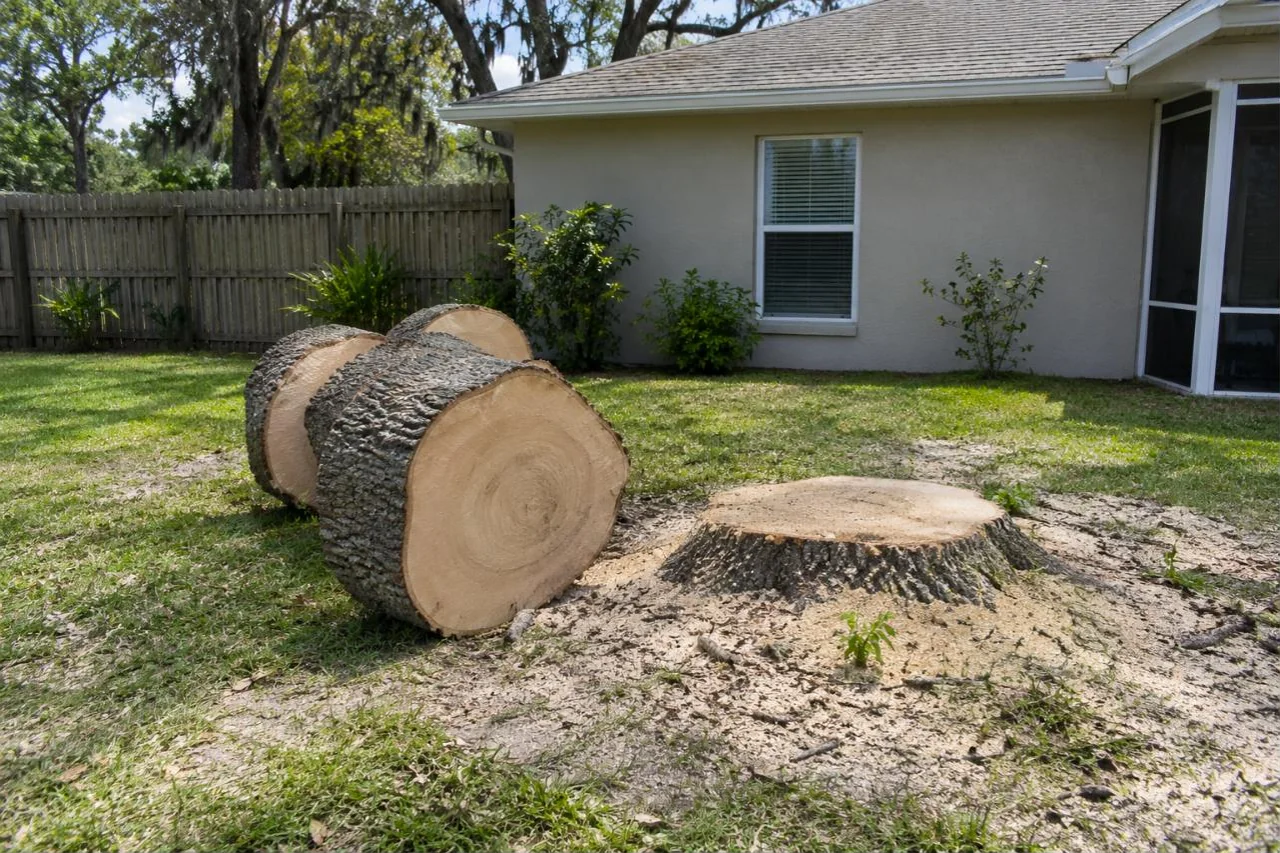
Yes, if you say so before the job is priced. Leaving the rounds where they fall usually takes hauling off the bill. Keep in mind the curbside limits above if you later change your mind.
Does Clay Electric take down trees for homeowners?
Clay Electric cuts danger trees beside its lines at the edge of its right-of-way, and in an August 2026 notice it said it may remove or reduce a tree along the edge of the right-of-way that threatens a line. It also said it "does not clean up, remove or haul away wood or debris from dead or hazardous trees" (checked Nov 12, 2026). Trees elsewhere in the yard are the owner's to deal with.
When you ask about a removal here, your details go to a single independent contractor in the Clay County area. The site itself does no tree work.
Sources checked for this page
- City of Green Cove Springs Land Development Code, Chapter 113, Article VII, Secs. 113-274 to 113-276, as amended by Ord. O-23-2023: the city's ordinance file and the Zoneomics copy of the code; city planning applications. Checked Nov 12, 2026.
- Clay County Land Development Code, Article VI, Tree Protection and Landscaping Standards; county Planning and Zoning FAQ. Checked Nov 12, 2026.
- Town of Orange Park, forms and applications; Keystone Heights code Secs. 17-219 to 17-227, Zoneomics copy. Checked Nov 12, 2026.
- Florida Statutes 163.045 (2026). Checked Nov 12, 2026.
- UF/IFAS, Quercus laurifolia: Laurel Oak and Wind and Trees: Lessons Learned from Hurricanes; USDA Forest Service Silvics, laurel oak and live oak; USDA Penney series. Checked Nov 12, 2026.
- NWS Jacksonville Irma report, in the Florida Climate Center's Irma summary. Checked Nov 12, 2026.
- Florida PSC, Hurricane Milton outage report, Oct 13, 2024; Clay Electric, vegetation management and "Dry conditions weaken trees near power lines", Aug 5, 2026; OSHA 29 CFR 1910.333; FPL, power line safety. Checked Nov 12, 2026.
- Clay County garbage and recycling, bulk waste, April 16, 2026 burn ban and Oct 18, 2024 debris bulletin; Green Cove Springs yard waste rules; Orange Park garbage and yard waste; Sunshine 811 after the storm. Checked Nov 12, 2026.
- HomeGuide, tree removal cost; Angi, how much does tree removal cost (2025 data); Fixr, tree removal, updated Jan 31, 2025; Thumbtack, tree removal. All checked Nov 12, 2026.