
First steps once the tree is down
- Clear everyone out of any room the tree has broken into, and stay out of it until someone has looked at the roof framing.
- Treat every wire as live. FPL's safety advice is to keep at least 10 feet away from any power line, measured from the end of your own reach, and to call 911 or the utility about a downed line (checked Nov 12, 2026). That includes the service wire to your house, which a falling limb can tear loose.
- Call the utility, or 911 if anyone is in danger. Numbers are in the table below.
- Take photos and video of the fallen tree, the roof, every damaged room, fences, cars and anything else hit, before anything is moved.
- Call your insurance company and write down the claim number.
- Limit further damage. Florida's Department of Financial Services lists "covering openings on the roof or removing tree limbs that could fall on the house" as examples of emergency steps to prevent more damage, and says, "When necessary, hire a professional and keep all receipts" (checked Nov 12, 2026).
Leave the roots alone until the area has been checked. Sunshine 811's storm advice says, "Before cutting away tree debris, check for buried lines tangled in the roots," and that a stump left by a storm needs an 811 call before a grinder touches it (checked Nov 12, 2026).
Phone numbers for downed trees and wires
| Who | For | Contact (checked Nov 12, 2026) |
|---|---|---|
| Anyone in danger | Downed lines near people, a tree blocking a road, injuries | 911 |
| Clay Electric Cooperative | Outages and lines down | 855-939-3840 |
| Clay Electric vegetation management | A tree threatening a line (not an emergency) | 1-800-511-5998 or vegmgt@ClayElectric.com |
| Green Cove Springs Electric | Outages and electric trouble inside the city's service area | 904-297-7094, Mon–Thu 7:00 a.m.–5:30 p.m.; after hours, 904-297-7300, option 7 |
| City of Green Cove Springs | Downed trees and outages by text | Text "Hi" to 904-560-5116 |
| FPL | Outages and downed lines | 1-800-468-8243 (1-800-4OUTAGE) |
| Clay County Public Works | County roads | 904-284-6335, weekdays 7 a.m.–3:30 p.m. |
| Florida Department of Financial Services | Insurance questions and claim problems | 1-877-693-5236 (1-877-MY-FL-CFO) |
Clay Electric serves most of the county: 91,399 of 101,600 accounts in an October 2024 Florida PSC report, with Green Cove Springs Electric at 4,781, JEA at 4,470 and FPL at 950 (checked Nov 12, 2026). If you're on JEA, use the number on your bill.
What past storms did in Clay County
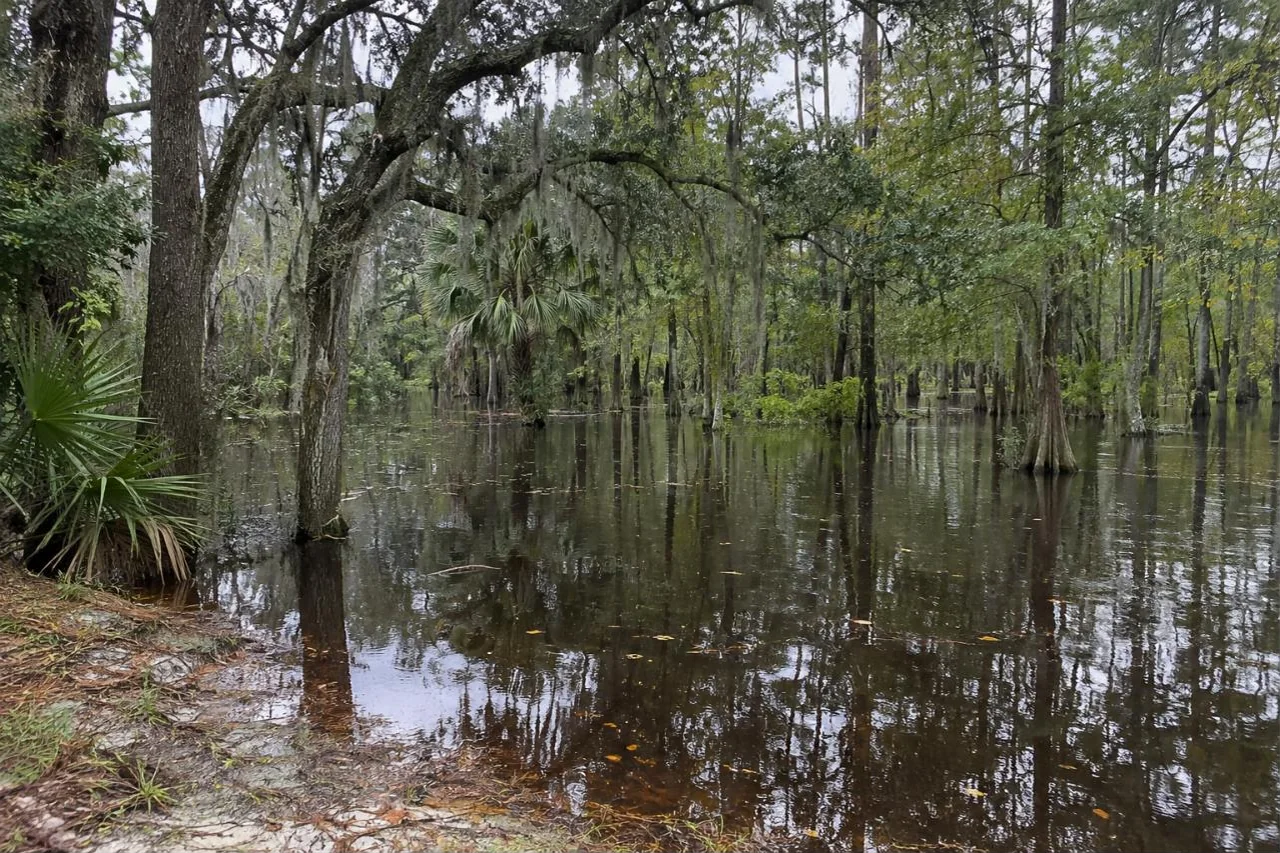
Hurricane Irma, September 2017. The National Weather Service office in Jacksonville reported widespread wind damage across Clay County, "including trees down, power lines down," and structural damage from tropical storm force winds. River waters rose past earlier major stage records, numerous riverfront homes lost property and had extensive dock and pier damage, and "several helicopter rescues occurred along Black Creek." Black Creek at Middleburg, at Blanding Boulevard, set a record flood stage of 30.52 feet. The Keystone Heights airport recorded a peak gust of 49 knots, about 56 mph. Statewide, the Irma summary by the Florida Climate Center at Florida State University says 72 people died in Florida as a result of Irma; that figure covers the whole state, not Clay County.
| Station | Inches |
|---|---|
| 8.8 miles east of Middleburg | 11.32 |
| 1.8 miles west-southwest of Orange Park | 11.03 |
| 2.6 miles west-northwest of Green Cove Springs | 10.48 |
| 1.8 miles east-southeast of Keystone Heights | 10.36 |
| Penney Farms | 7.46 |
The St. Johns River Water Management District, measuring a different way, put Clay County's Irma rainfall at 13.5 inches. Clay Electric told the Florida Public Service Commission that at the storm's peak on September 11, 2017, 69,947 of its 79,841 Clay County meters were out, and that it had 208 vegetation management workers on the restoration. A year earlier, Hurricane Matthew had cut power to 34,686 of 78,406.
The storms since. OpenFEMA's records list these declarations naming Clay County (checked Nov 12, 2026):
| Storm | Declared | What Clay County received |
|---|---|---|
| Hurricane Matthew | Oct 8, 2016 | Public assistance including debris removal; no help for households |
| Hurricane Irma | Sep 10, 2017 | Individual assistance for households, plus public assistance including debris removal |
| Dorian, Isaias, Elsa | 2019, 2020, 2021 | Emergency declarations |
| Ian, Nicole, Idalia | 2022, 2022, 2023 | Public assistance for protective measures only, plus hazard mitigation; no debris category |
| Hurricane Debby | Aug 10, 2024 | Public assistance including debris removal |
| Hurricane Helene | Sep 28, 2024 | Public assistance including debris removal (Clay added Nov 22, 2024) |
| Hurricane Milton | Oct 11, 2024 | Individual assistance for households, plus public assistance including debris removal |
The Weather Service's regional report on Debby named no Clay County station, but North Fork Black Creek near Middleburg crested at 20.21 feet on August 6, 2024, above its 20-foot major flood stage. No FEMA declaration names Clay County for a 2025 or 2026 hurricane in the data refreshed November 6, 2026.
Why trees tip over in wet sand
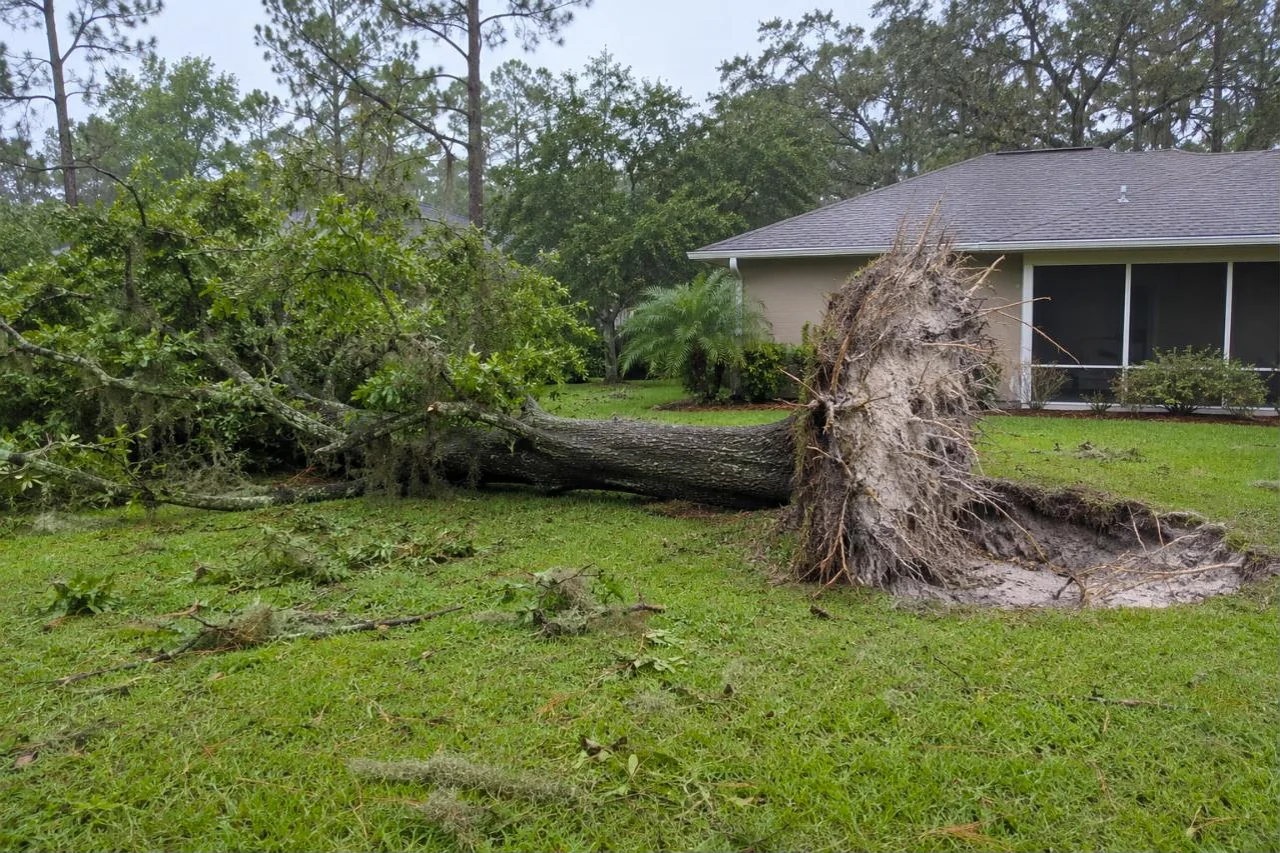
A tree uprooted by a hurricane often comes up as a broad, shallow plate of sand and roots, leaving a shallow pit. The Forest Service sources describe why some trees here are prone to it (checked Nov 12, 2026): water oak "has a shallow, spreading rooting habit"; slash pine "is subject to windthrow on shallow soils and wherever it does not develop a strong root system"; and longleaf pine, normally deep-rooted, loses windfirmness "If the hardpan is close to the surface." In Irma, four of the five Clay County stations listed above recorded more than 10 inches of rain in the report's 24-hour totals, on top of the wind.
Roots damaged earlier make it worse. The UF/IFAS hurricane paper warns that "When roots under the canopy are cut, trees are more predisposed to falling over," so a tree near a recent trench, driveway or pool job deserves a second look before the next storm.
Homeowner's insurance after a hurricane
Florida's rules on hurricane deductibles shape what a claim is worth (checked Nov 12, 2026):
- How big. Hurricane deductibles are "typically 2, 5 or 10 percent of the amount of insurance covering the dwelling," per the Department of Financial Services. Under Florida Statute 627.701, insurers must offer $500, 2%, 5% and 10% options, unless the percentage works out to less than $500.
- When it applies. The hurricane deductible period begins when the National Hurricane Center issues a hurricane warning for any part of Florida and ends 72 hours after the last hurricane watch or warning anywhere in the state ends.
- Once a year. It applies on a calendar-year basis to all covered hurricane losses, so after one hurricane claim you generally don't pay a second hurricane deductible that year with the same insurer.
- File anyway. DFS's homeowners toolkit says that even if a hurricane loss is below the deductible, "you should still file a claim with your insurance company" and "save all invoices and receipts," because the deductible is cumulative over the year.
- Deadlines. Under Florida Statute 627.70132, notice of a new or reopened property claim is due within 1 year of the date of loss, and a supplemental claim within 18 months. DFS's claims guide lists 7 days for the insurer to acknowledge a claim and 60 days to pay the undisputed portion.
Coverage for removing a fallen tree, debris removal limits and a neighbor's tree that lands on your house all depend on your policy's wording. Read those sections, ask your adjuster, and call the DFS helpline at 1-877-693-5236 if you get stuck. Among recent storms, FEMA's individual assistance for Clay County households came only after Irma and Milton, and it isn't a source of payment for clearing private trees.
Storm debris at the curb
After a declared storm, the county's storm debris rules take over from everyday yard waste limits. In its October 18, 2024 bulletin after Helene, Clay County said, "You must separate tree limbs and vegetative debris from items like wooden fencing," and asked that piles go by the road but not against trees, electrical boxes, poles, hydrants or storm drains. Vegetative debris pickup had started October 7 and ran seven days a week, with a storm debris call center at 877-CLAYEOC, 8 a.m. to 5 p.m. on weekdays. Sunshine 811 separately warns not to pile debris over utility boxes, pedestals or transformers.
Public pickup takes what's at the curb. Getting a trunk off a roof, out of a pool enclosure or out of the backyard is up to the homeowner, usually with a contractor.
Storm prices and Florida's gouging law
Storm work is priced differently from a routine removal, and national guides show how wide the range gets (checked Nov 12, 2026): HomeGuide lists storm damage or emergency tree removal at $150 to $250 per hour; Fixr's emergency range runs from $450 to $5,000; and Angi says paying up to $5,000 when the work is urgent "isn't unheard of."
Florida Statute 501.160 sets the limit. After the Governor declares an emergency, it is unlawful to charge an "unconscionable price" in the affected area for goods or services needed because of it. The yardstick is the 30 days before the declaration: a price grossly out of line with the average then is presumed unconscionable, unless increased costs or market trends account for it. Because the statute's definition of commodity includes "services," storm tree work falls under it. Complaints go to the Florida Attorney General, whose complaint page has a price-gouging reporting form; its consumer protection line is (850) 414-3300 (checked Nov 12, 2026).
If someone knocks on your door after a storm and you sign there, Florida's three-business-day cancel right for home solicitation sales may apply. The hiring guide explains it.
In the weeks and months after
Damage doesn't always show at once. A UF/IFAS study of hurricanes found that three months after Hurricane Charley, 27% of standing south Florida slash pines and 48% of standing longleaf pines had died, "likely due to hidden damage produced by bending and twisting during hurricane-force winds" (checked Nov 12, 2026). UF/IFAS also notes that southern pine beetle outbreaks often start in injured trees, typically after lightning, and advises removing severely damaged pines rapidly. Watch for crowns that fade from green to yellow to red; the dead or leaning trees guide explains the signs.
For trees damaged but still standing, the local rules still apply, with emergency routes: Clay County exempts a protected tree posing imminent danger that needs removal without delay, with authorization; Green Cove Springs lets its development services director verbally authorize an immediate removal for property that isn't already exempt; and Florida Statute 163.045 covers a documented unacceptable-risk tree at a single-family home. See the rules guide.
Storm cleanup questions
Will Clay Electric remove the tree that fell on my service line?
It will deal with its lines and may remove or cut back a tree along the edge of its right-of-way that threatens one. But in August 2026 it said it "does not clean up, remove or haul away wood or debris from dead or hazardous trees" (checked Nov 12, 2026). The wood in your yard stays your responsibility.
Should I cut up a tree that's leaning on wires myself?
No. The federal OSHA rule keeps workers who aren't qualified for line work at least 10 feet from energized lines up to 50 kilovolts, and FPL says only specially trained line-clearing professionals should work around power lines. Call the utility first.
The tree missed the house. Is it still urgent?
If it's on the ground and clear of wires, it can usually wait for daylight and a proper look. If it's hung up in another tree, leaning on the house or tangled in lines, it's under tension and dangerous to approach; keep people and pets away until it's handled.
Is a permit required for a tree the storm already damaged?
Usually not for a home in Green Cove Springs. In the unincorporated county, newer major-subdivision lots fall under the 4-inch rule, but the code has an imminent-danger exemption with authorization, and the state's hazard-tree law is another route. Ask Clay County Zoning at (904) 278-4705 if you're unsure (checked Nov 12, 2026).
After a storm, a request made here is handed to one independent contractor based in the Clay County area. The site itself sends no crews.
Sources checked for this page
- NWS Jacksonville post-tropical cyclone report on Irma (Sep 22, 2017), reprinted as Appendix C of the Florida Climate Center's Irma summary (Dec 1, 2017); St. Johns River Water Management District, Oct 10, 2017 release; NOAA National Water Prediction Service, gauge MDLF1; NWS Jacksonville Debby report. Checked Nov 12, 2026.
- OpenFEMA disaster declarations for Clay County and declaration areas (refreshed Nov 6, 2026). Checked Nov 12, 2026.
- Clay Electric Cooperative, hurricane report to the Florida PSC (Dec 21, 2017), vegetation management and Aug 5, 2026 notice; Florida PSC, Milton outage report; City of Green Cove Springs, Report Outages and hurricane preparedness; FPL, power line safety; OSHA 29 CFR 1910.333. Checked Nov 12, 2026.
- Sunshine 811, after the storm; Clay County, Oct 18, 2024 debris bulletin and Public Works. Checked Nov 12, 2026.
- Florida DFS, hurricane deductible guide (revised May 2025), homeowners insurance toolkit (revised March 2024) and post-disaster claims guide (July 2024); Florida Statutes 627.701, 627.70132 and 501.160 (2026); Florida Attorney General, file a complaint and consumer protection. Checked Nov 12, 2026.
- UF/IFAS, Wind and Trees: Lessons Learned from Hurricanes and The Southern Pine Beetle; USDA Forest Service Silvics, water oak, slash pine and longleaf pine. Checked Nov 12, 2026.
- HomeGuide, tree removal cost; Fixr, tree removal; Angi, tree removal cost. Checked Nov 12, 2026.